
August 9, 2026 — Beyond the Bit Security Trailers
What does one security guard actually cover?
One guard on one post covers one direction at a time, for the length of one shift. A standard unarmed static post runs eight to twelve hours, which means an eight-hour shift leaves sixteen hours of the day uncovered unless a second guard clocks in behind the first — and a third behind that one if the site runs a graveyard shift too.
That's not a knock on guards. A person at a gate can check IDs, sign for a delivery, wave off a wrong turn, and make a judgment call a camera can't. What a single guard cannot do is watch the back fence line while standing at the front gate, or keep watching either one after the shift ends and the truck pulls out.
Why does round-the-clock guard coverage cost more than it looks like it should?
Because round-the-clock isn't one job, it's three or four. Covering a site twenty-four hours a day, seven days a week means stitching together three eight-hour shifts every single day, plus a rotation deep enough to absorb weekends, holidays, and the guard who calls in sick at 5 p.m. That's several salaries stacked on top of each other, not one.
Rates commonly quoted by DFW guard companies for an unarmed static post run in the neighborhood of $20 to $35 an hour, more for an armed post — and that's before overtime, holiday premiums, or the markup a vendor charges for filling a shift on short notice. Multiply that by three or four shifts a day, seven days a week, for the length of a project, and the number a superintendent signs off on grows every week the site stays open. None of it buys a second set of eyes on the material yard while the one guard you've got is checking a delivery at the gate.
What does a monitored camera trailer watch that a guard can't?
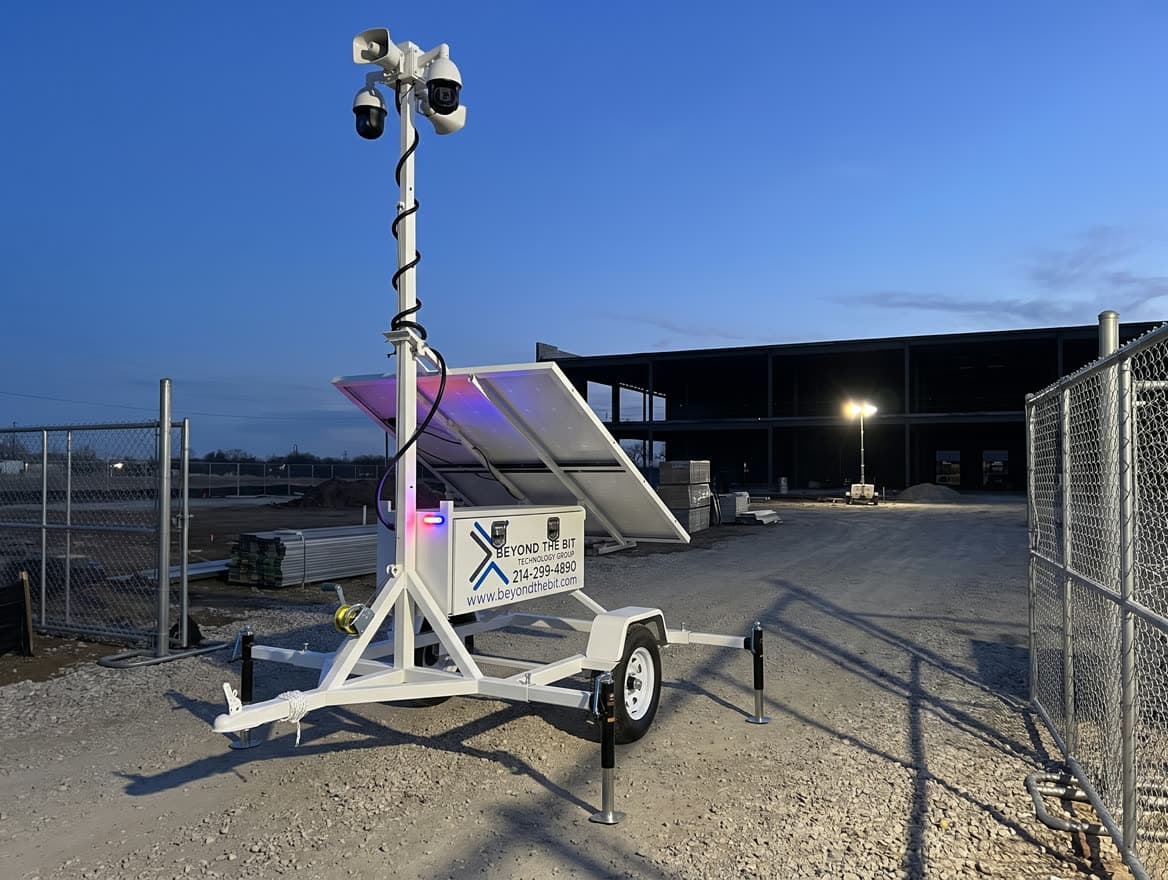
A trailer's cameras cover the same ground every second of every shift, without a break, a schedule gap, or a spot the guard happened to be facing the other way. The cameras categorize what they see — person, vehicle, bicycle — and zones can be masked off so the public road running past the site doesn't trip an alert every time a car drives by.
That distinction matters more than it sounds like it should. A guard's attention is finite; a person can only look one direction, and after hour seven of a twelve-hour shift, that attention isn't what it was at hour one. A camera doesn't get tired, and it doesn't need to choose between the gate and the back fence — it watches both, all night, for as long as the trailer is on site.
Does a camera trailer ever blink, clock out, or miss a section of fence line?
No, because detection and response are split between a machine and a person, and neither one works alone. The cameras flag motion the instant it happens. A live operator at our Texas-licensed third-party monitoring partner looks at the video within moments, decides whether it's a real problem, and can trigger a strobe and a live audio warning through the trailer's speaker before anyone else even knows something happened. If the situation doesn't resolve, the operator works a call list and contacts police.
In Dallas, that last step is the whole ballgame — police don't dispatch on an unverified alarm, only a verified one. A guard calling 911 from a gate shack is one version of verification. A live operator watching real-time video is another, and it doesn't depend on whether anyone happened to be looking at the right moment.
What happens when a guard doesn't show up for a shift?
The site goes uncovered until someone else can get there. Guard staffing runs on people showing up, and people call in sick, get stuck in traffic, or quit without much notice — a vendor with a thin bench on a given night may not have a replacement ready to send, and the gap between the missed shift and the backup arriving is exactly when a site is most exposed. It's not a knock on any one guard company; it's a structural risk that comes with staffing coverage around people instead of equipment.
A trailer doesn't have a bench problem. Once it's installed and the monitoring center is watching, it doesn't call in sick, doesn't need a replacement mid-shift, and doesn't have a night where coverage depends on whether a dispatcher found someone in time.
How does procurement actually work for each option?
Both options move through a similar approval path on a commercial job — a quote, a project manager's sign-off, and a spot in the general requirements budget — but the paperwork underneath looks different. A guard contract usually runs on a rate card with shift minimums, overtime clauses, and a renewal or cancellation window buried in the service agreement. A trailer rental is a single line: one monthly rate, one vendor packet, one point of contact if something needs to change. The procurement and licensing questions that come up most often are worth reading before either quote goes to a PM.
On the vendor-compliance side, a serious trailer provider should be able to hand over a W-9, a certificate of insurance, and net-30 terms without back-and-forth — the same paperwork a general contractor already expects from any subcontractor or vendor on the job. If a provider can't produce that on request, that's worth noticing before a quote turns into a signed order.
What's actually included in a trailer's one flat monthly rate?
Everything the trailer needs to run itself, quoted as a single monthly rate per site — no hourly math, no shift math, no separate line item for the week a guard vendor has to scramble to fill a call-out.
Included in every trailer rental
There's no fuel surcharge, no overtime clause, no separate bill for a night someone actually had to respond — the strobe and the live voice end most nights before anyone reaches the fence line anyway. Whatever the site needs from the trailer that month, it's already in the number a superintendent takes to the general requirements budget.
When does a guard and a trailer together beat either one alone?
A lot more often than people assume. Plenty of DFW sites run a hybrid: a guard on the gate during working hours for deliveries, visitor traffic, and the judgment calls only a person can make, and a monitored trailer covering the material staging area and the rest of the fence line once the crew and the daytime guard both go home.
That split plays to what each one is actually good at. The guard handles the parts of the day that need a face and a decision — the delivery driver who needs a signature, the visitor who needs directions to the trailer office, the judgment call about whether a truck belongs on site. The trailer handles the parts of the day — which, on most jobsites, is most of the day — where nobody is watching at all unless something is.
For a superintendent weighing the two, the honest comparison isn't guard versus trailer in the abstract. It's what specific hours and what specific ground on this site actually need watching, and which model — one, the other, or both together — closes that gap without paying for coverage the site doesn't need.