
August 9, 2026 — Beyond the Bit Security Trailers
Why doesn't Dallas PD respond to a triggered alarm?
Because since 2006, Dallas has run a verified-response policy: officers are not dispatched to a commercial burglar alarm until something confirms a person is actually there. A siren going off on its own, with no other evidence behind it, does not put a patrol car in motion.
That's a real shift from how most people picture an alarm working. The old assumption — panel trips, siren sounds, police show up — hasn't matched how Dallas handles commercial alarms in close to two decades. The ordinance exists because the old model was drowning the department in calls that led nowhere.
How many alarm calls turn out to be nothing?
The overwhelming majority. Alarm industry groups and police departments across the country have for years reported that somewhere in the 90-percent-plus range of traditional burglar alarm activations are false — a door not latched right, a moth on a sensor, a gust of wind, an employee who forgot the code. Exact figures vary by city and by year, but the pattern holds nearly everywhere: most alarms are noise, not signal.
Dispatch a squad car to every one of those and you've spent real police hours on empty buildings while calls involving actual people wait longer. Dallas isn't unusual in drawing that conclusion — plenty of major Texas cities lean on some version of verified response for the same reason.
None of that means alarms are useless. It means a signal alone — a triggered panel with nothing behind it — isn't enough on its own to justify sending an officer, and that a property owner who wants an actual response has to provide something more than the signal itself.
What is video verification, and how is it different from a standard alarm?
Video verification means a live person looks at real footage before anyone calls police — so the report isn't "the alarm went off," it's "there is a person on your property right now, and here's what they're doing." That distinction is what turns a call into a dispatch.
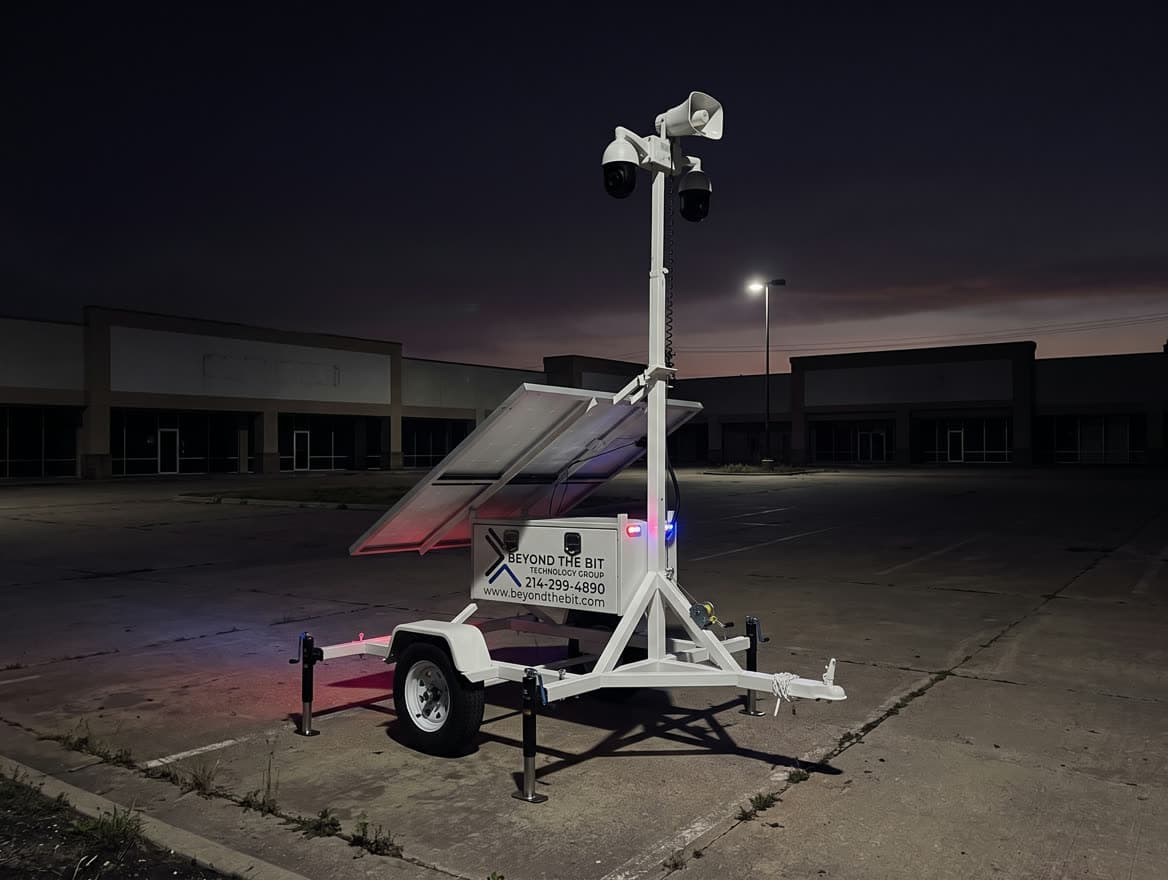
On a monitored security trailer, that process runs in a specific order. Cameras detect motion and categorize it — person, vehicle, bicycle — with zones masked off so a public sidewalk or road doesn't trigger a false alert every time someone walks or drives past. A live operator at our Texas-licensed third-party monitoring partner reviews the video within moments. If it's real, the operator can trigger the trailer's strobe and deliver a live audio warning through its speaker, work a customizable call list to confirm who should and shouldn't be on site, and contact police once the situation is confirmed.
What gets a Dallas PD dispatch
What does this mean for a construction site or vacant commercial property?
It means a traditional door-and-window alarm system is close to useless on its own for the kind of property that has neither — most jobsites and vacant commercial buildings don't have a monitored front door, they have open ground, staged material, and equipment sitting in the open. A trip-wire alarm has nothing to trip.
A monitored camera trailer is built around the same verification standard the ordinance rewards. It doesn't wait for someone to break a window; it watches the open yard, the material staging area, and the equipment row directly, and it generates its own verification the moment something crosses into frame. That's the same standard that gets a response anywhere else in the city, applied to ground that never had an alarm system to trip in the first place.
How does Dallas's approach compare to the rest of Texas?
Dallas isn't an outlier — it's one of a number of major Texas cities that lean on some version of verified response for commercial alarms, for the same reason: unverified calls were consuming patrol hours that could go to confirmed incidents. Policies differ in the details from one city to the next, and requirements can change, so a superintendent or property owner working across multiple Texas metros shouldn't assume the rule that applies in Dallas applies identically everywhere else. What's consistent across most of them is the underlying logic: a person confirming a real event on video or in person is worth more to a dispatcher than a signal with no context behind it.
That's worth knowing even for property outside Dallas proper. A site in a neighboring suburb or a different county may not fall under the same ordinance, but the direction most departments are moving is the same — toward some form of verification before dispatch, not away from it.
What should a property owner or superintendent actually do about it?
Stop assuming a triggered alarm alone gets a response, and build in a way to verify what actually happened. For a site with a real building, that might mean upgrading a traditional alarm to include video verification. For a jobsite or vacant lot with no building to alarm in the first place, it means covering the open ground directly with something that can see and confirm activity on its own — which is the gap a monitored camera trailer is built to close.
Either way, the goal is the same: don't let the first call to police be an unverified one. A live operator watching real video, ready to describe exactly what's happening on the property, is what turns a call into a dispatch instead of a report that sits in a queue.
Do I still need an alarm permit in Dallas?
In most cases, yes — Dallas requires a permit for monitored alarm systems on commercial property, and that requirement sits alongside, not instead of, the verified-response policy. Permit rules and fees change, so check current requirements with the city rather than relying on secondhand numbers, and confirm with whoever installs your monitoring what's required for your specific site and system.
A licensed provider should be able to walk you through what's needed before anything goes live. Beyond the Bit holds a Texas alarm systems license under Occupations Code Chapter 1702, and the monitoring partner behind every trailer is Texas-licensed as well — ask any provider you're comparing whether they can say the same.
What happens after a trailer flags something real?
The chain runs detect, verify, warn, respond — in that order, every time. Motion gets categorized and checked against the masked zones. A live operator verifies what's actually happening on camera. The trailer's strobe and speaker deliver a warning most people leave before finishing. And if it's still unresolved, the operator works your call list and brings in police with the one thing an unverified alarm never has: confirmation that someone is really there.